
Christmas Cookies: 10 Classic Recipes + a Make-Ahead Baking Plan
A good Christmas cookie tray mixes textures and flavors: something buttery, something chocolatey, something spiced, something with jam and something no-bake. This guide gathers our Christmas cookie recipes in one place, shows which ones you can bake weeks ahead, and gives you a day-by-day baking plan so the oven never becomes a bottleneck. At the end you’ll find one bonus recipe written out in full: classic spritz butter cookies.
Christmas Cookies at a Glance
Use this table to build a balanced tray. “Dough freezes” means you can freeze the raw dough and bake later; “Baked cookies freeze” means the finished, undecorated cookies freeze well.
| Cookie | Style | Dough freezes | Baked cookies freeze | Best for |
|---|---|---|---|---|
| Cut-out sugar cookies | Buttery, crisp edges, soft center | Yes (discs, 3 months) | Yes, before icing | Decorating with kids |
| Gingerbread cookies | Spiced molasses cut-outs | Yes (3 months) | Yes, before icing | Gingerbread people, ornaments |
| Chocolate crinkle cookies | Fudgy, powdered-sugar crackle | Yes, as balls (roll in sugar after thawing) | Yes | Chocolate lovers |
| Jam thumbprint cookies | Buttery with a jam center | Yes, as balls | Yes, but jam may weep slightly | Color on the tray |
| 3-ingredient shortbread | Short, sandy, rich | Yes (log, 3 months) | Yes | Fast, pantry-only baking |
| Cranberry pistachio shortbread | Slice-and-bake, red and green | Yes (log, 3 months) | Yes | Gift boxes |
| Italian wedding cookies | Nutty snowballs | Yes, as balls | Yes (re-dust with sugar) | Cookie exchanges |
| Gluten-free Christmas cookies | Almond flour, 3 shapes | Yes | Yes | Guests who avoid gluten |
| Peppermint bark | No-bake chocolate layers | — | Not recommended (bloom) | Last-minute gifts |
| Spritz butter cookies (recipe below) | Piped, crisp, buttery | No (pipe fresh) | Yes | Big batches, fast |
How to Plan Your Christmas Cookie Baking
Baking six kinds of cookies in one day is stressful. Spreading the work over two weeks is not. This plan assumes you want five or six varieties ready by Christmas Eve.
| When | What to do |
|---|---|
| 2–3 weeks ahead | Mix and freeze shortbread logs, sugar cookie discs and gingerbread dough. Wrap twice (plastic wrap, then a freezer bag) and label with the date and oven temperature. |
| 10–14 days ahead | Bake shortbread and slice-and-bake cookies straight from the freezer (add 1–2 minutes). Cool completely, then freeze in airtight containers. |
| 5–7 days ahead | Thaw cut-out dough overnight in the fridge, roll, cut and bake. Freeze undecorated or store airtight at room temperature. |
| 3–4 days ahead | Decorate cut-outs; royal icing needs 8–12 hours at room temperature to dry hard enough to stack. Bake crinkles and Italian wedding cookies. |
| 1–2 days ahead | Bake thumbprints (jam stays brightest when fresh), pipe spritz cookies and make peppermint bark. |
| The day you serve | Thaw frozen cookies in their closed containers for 1–2 hours so condensation forms on the box, not the cookies. Re-dust snowballs and crinkles with powdered sugar. |
One-Oven Tips
- Group cookies by temperature. Most butter cookies bake at 350°F (175°C); the almond flour gluten-free dough bakes lower at 325°F (165°C), so do it first or last, after an oven thermometer confirms the change.
- Bake one sheet at a time on the middle rack for even color. Two sheets at once usually need rotating halfway and 1–2 extra minutes.
- Keep at least three sheet pans in rotation and always load cookies onto a cool pan. Dough on a hot pan spreads before it sets.
- Weigh flour. 1 cup of all-purpose flour is about 125 g when spooned and leveled; a scooped cup can be 150 g or more, which makes cookies dry and crumbly. Our butter conversion chart covers sticks, tablespoons and grams.
Bonus Recipe: Classic Spritz Butter Cookies
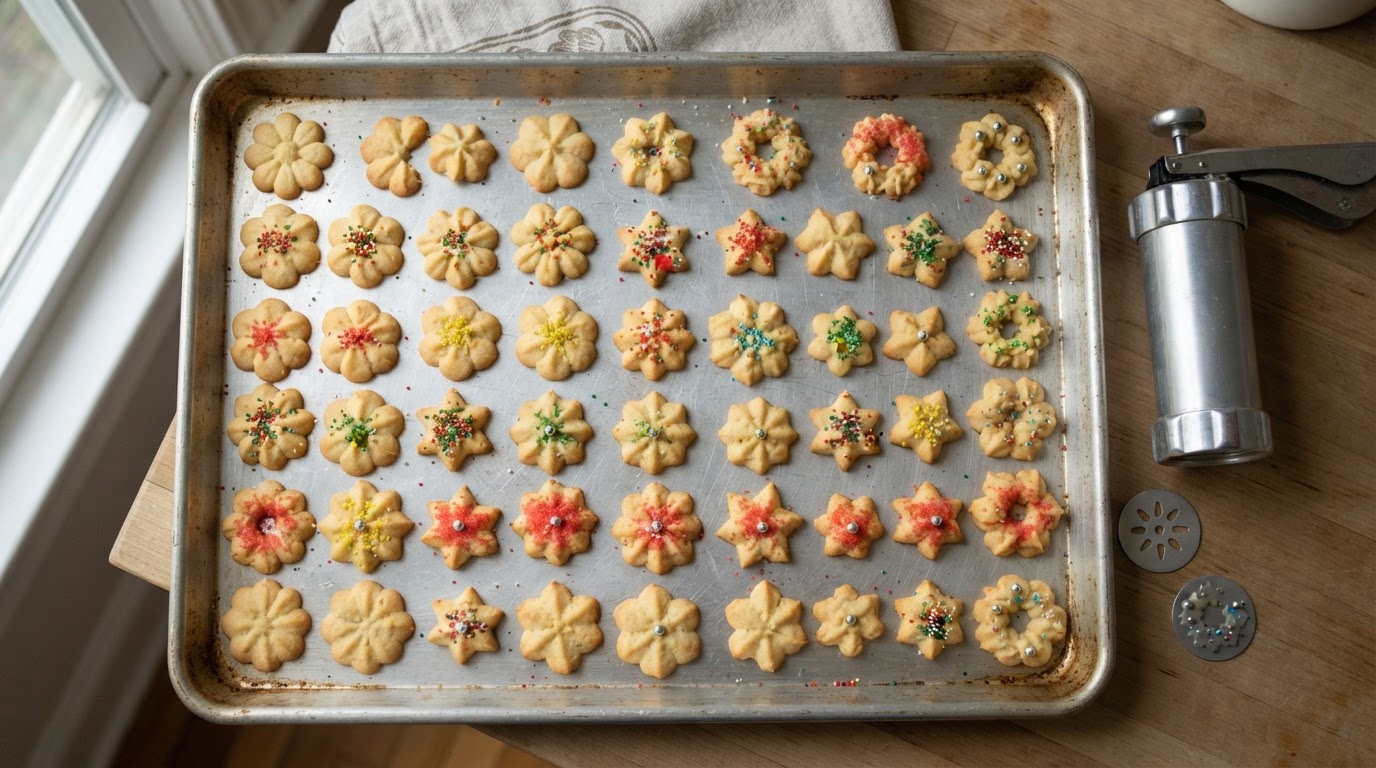
Spritz cookies are pressed or piped from a soft butter dough and need no chilling, which makes them the fastest way to fill a tray. The dough must be soft enough to press but not greasy, so start with butter that is cool room temperature, about 65°F (18°C).
Yield: about 60 small cookies · Prep: 20 minutes · Bake: 8–10 minutes per sheet · Total: about 50 minutes · Oven: 375°F (190°C)
Ingredients
- 1 cup (2 sticks / 226 g) unsalted butter, softened to about 65°F (18°C)
- 2/3 cup (133 g) granulated sugar
- 1 large egg (50 g out of the shell), room temperature
- 1 teaspoon (5 ml) pure vanilla extract
- 1/2 teaspoon (2.5 ml) almond extract (optional, but classic)
- 1/4 teaspoon (1.5 g) fine salt
- 2 1/4 cups (281 g) all-purpose flour, spooned and leveled
- Optional: 2–3 drops gel food coloring; 2 tablespoons (25 g) colored sanding sugar or sprinkles
Method
- Heat the oven to 375°F (190°C) with a rack in the middle. Leave the baking sheets ungreased and unlined: the dough needs to grip bare metal to release from the press. Keep the sheets cool.
- Beat the butter and sugar with a mixer on medium speed for 2 minutes, until pale and creamy.
- Add the egg, vanilla, almond extract and salt (and food coloring, if using). Beat for 30 seconds, scraping the bowl.
- Add the flour on low speed and mix only until no dry streaks remain. The dough should be soft and smooth, like stiff frosting.
- Load the dough into a cookie press (or a piping bag fitted with a large open star tip, about 1/2 inch / 1.3 cm). Press or pipe cookies 1 inch (2.5 cm) apart. If using sprinkles, add them now.
- Bake one sheet at a time for 8–10 minutes, until the edges are just light golden and the tops are still pale.
- Cool on the sheet for 2 minutes, then move to a wire rack. Let the sheet cool completely (or run it under cold water and dry it) before pressing the next batch.
Spritz Troubleshooting
- Cookies won’t stick to the pan: the pan is greased, lined, nonstick-coated or warm. Use a cool, bare aluminum sheet.
- Dough is too stiff to press: the butter was too cold or the flour was over-measured. Beat in 1–2 teaspoons (5–10 ml) of milk.
- Shapes lose their ridges: the dough is too warm. Refrigerate the filled press for 10 minutes, but do not chill the dough hard.
- Brown bottoms: dark pans or a too-low rack. Use a light-colored sheet on the middle rack and start checking at 7 minutes.
How to Store and Gift Christmas Cookies
| Cookie type | Room temperature (airtight) | Freezer |
|---|---|---|
| Shortbread, spritz, sugar cookies | Up to 1–2 weeks | Up to 3 months |
| Iced cut-outs (royal icing, fully dry) | Up to 1 week | Up to 1 month; icing colors may bleed slightly |
| Crinkles and snowball cookies | Up to 5 days | Up to 3 months; re-dust with sugar |
| Jam thumbprints | Up to 5 days | Up to 2 months |
| Peppermint bark | Up to 2 weeks in a cool spot below 70°F (21°C) | Not recommended |
- Store crisp and soft cookies in separate containers. Soft cookies release moisture and make crisp ones go limp.
- Keep strongly flavored cookies (gingerbread, peppermint) apart from delicate butter cookies so the flavors don’t transfer.
- For gift boxes, line with parchment, pack the heaviest cookies on the bottom and fill gaps with crinkled parchment so nothing slides. Pack bark and iced cookies in their own sections.
- Need a quick glaze for undecorated cookies? Use our powdered sugar icing. Out of powdered sugar? Make icing sugar at home in a blender.
More No-Bake Holiday Treats
If the oven is full, fill the tray with treats that set in the fridge: peppermint bark, easy condensed milk fudge and no-bake Oreo balls.
Christmas Cookies FAQ
How far ahead can I make Christmas cookies?
Most butter-based cookie doughs freeze for up to 3 months, and most baked, undecorated cookies freeze for up to 3 months in an airtight container. At room temperature, crisp cookies like shortbread keep 1–2 weeks; softer cookies are best within 5 days.
How many kinds of Christmas cookies should I make?
Four to six kinds give a varied tray without overwhelming your schedule. Aim for one buttery cookie, one chocolate, one spiced, one with fruit or jam and one no-bake treat.
Why did my cut-out cookies spread?
The usual causes are warm dough, butter that was too soft, too little flour or a hot baking sheet. Chill cut shapes on the sheet for 10–15 minutes before baking, and always use a cool pan.
Which Christmas cookies ship best?
Sturdy, low-moisture cookies travel best: shortbread, spritz, sugar cookies and gingerbread. Avoid shipping cookies with soft fillings or anything that melts, like bark, in warm weather.
How do I thaw frozen cookies?
Leave them in the closed container at room temperature for 1–2 hours. Opening the container too early lets condensation form on the cookies and makes them soggy or sticky.