Almond Flour Pie Crust (Gluten-Free, Roll or Press-In)
This almond flour pie crust is a gluten-free, grain-free single crust for a standard 9-inch (23 cm) pie plate. It is made from 2 cups (224 g) of blanched almond flour, cold butter and one egg, so it can be rolled between two sheets of parchment instead of pressed in like a cookie crust. Use it for pumpkin, custard, cream, lemon or chocolate pies, or leave out the sweetener for quiche.
- Yield: one 9-inch (23 cm) single pie crust, about 360 g dough (8 slices)
- Prep: 15 minutes + 20 minutes chilling
- Blind bake: 10–12 minutes (partial) or 15–18 minutes (full) at 350°F (175°C)
- Total: about 55 minutes for a fully baked, cooled shell
- Equipment: food processor or bowl and pastry cutter, parchment paper, rolling pin, 9-inch standard (not deep-dish) pie plate, foil
Ingredients
- 2 cups (224 g) blanched, finely ground almond flour (not coarse almond meal)
- 2 tablespoons (16 g) tapioca starch or arrowroot (makes the dough more pliable; optional for a press-in crust)
- 1 tablespoon (12 g) granulated sugar, or 1 tablespoon (12 g) granulated allulose or monk fruit–erythritol blend for a sugar-free crust; omit for savory pies
- ¼ teaspoon (1.5 g) fine salt
- 4 tablespoons (56 g) cold unsalted butter, cut in ½-inch (1 cm) cubes, or 4 tablespoons (52 g) solid coconut oil for a dairy-free crust
- 1 large egg (about 50 g out of the shell), cold
How to Make Almond Flour Pie Crust
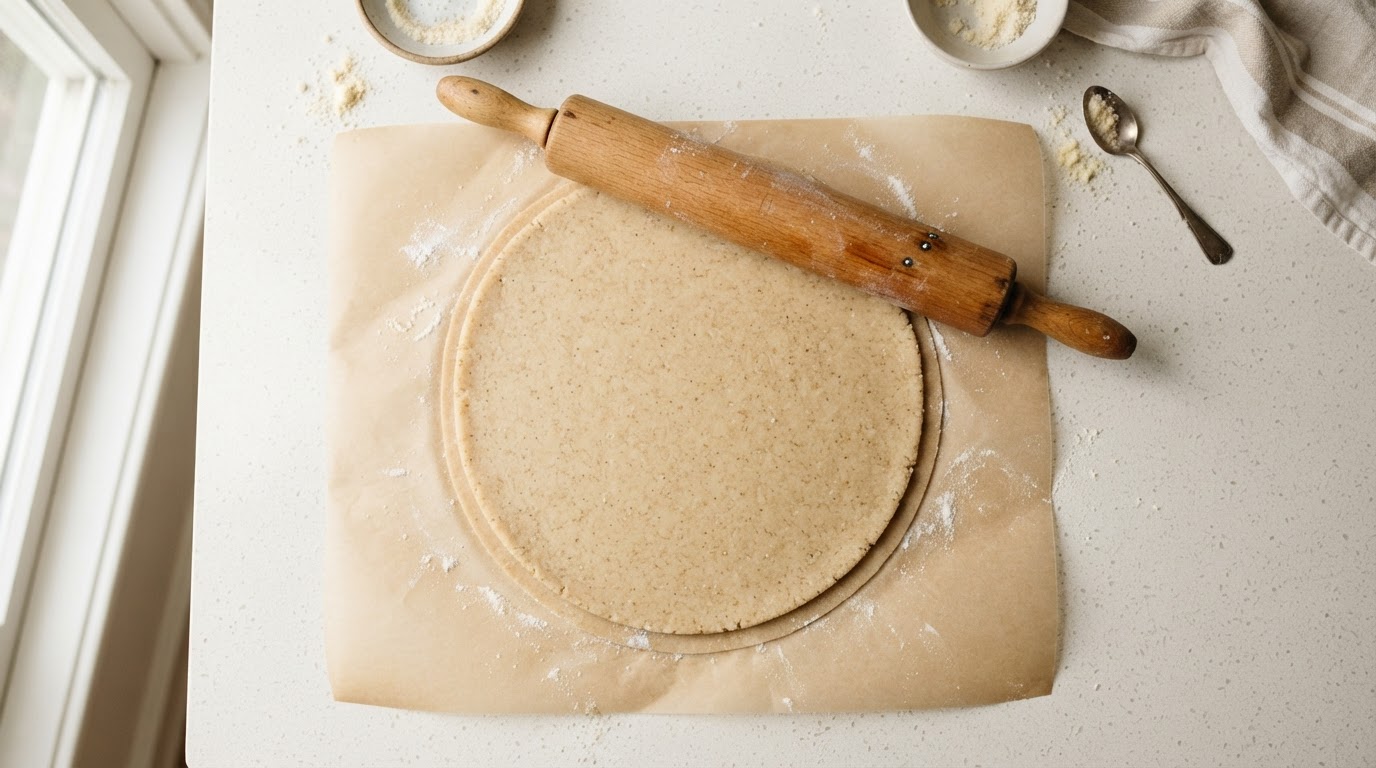
- Mix the dry ingredients. Pulse the almond flour, tapioca starch, sugar or sweetener and salt in a food processor 3–4 times to break up lumps.
- Cut in the butter. Add the cold butter cubes and pulse 8–10 times, until the mixture looks like damp sand with a few pea-size pieces. By hand, use a pastry cutter or your fingertips.
- Add the egg. Add the egg and pulse until the dough clumps and pulls into a ball, about 15–20 seconds. It will feel softer and stickier than wheat pie dough.
- Roll between parchment. Flatten the dough into a disk, set it between two sheets of parchment and roll to an 11-inch (28 cm) circle about ⅛–3/16 inch (3–5 mm) thick.
- Chill. Slide the rolled dough, still in parchment, onto a baking sheet and refrigerate for 20 minutes (or freeze 10 minutes) until firm.
- Transfer to the pie plate. Peel off the top sheet, flip the dough into the pie plate and peel off the second sheet. Press it into the corners and patch any cracks with your fingers; trimmings press in easily. Crimp the edge with a fork or your fingers, keeping it level with the rim (a tall edge overbrowns).
- Dock and chill again. Prick the base all over with a fork and freeze the crust for 15 minutes while the oven heats to 350°F (175°C).
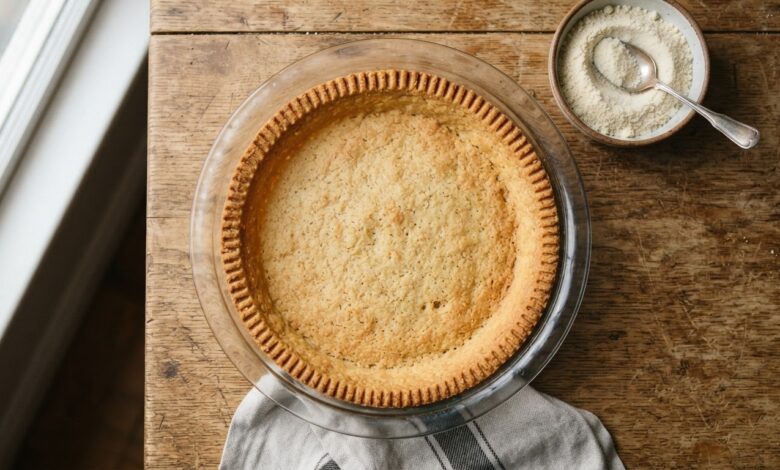
- Blind bake. Bake on the middle rack. After 8 minutes, cover the edge with a foil ring or pie shield. For a pie that bakes with its filling (pumpkin, custard, quiche), stop at 10–12 minutes, when the base looks dry and pale golden. For a no-bake filling (cream, lemon curd, mousse), bake 15–18 minutes total, until evenly golden.
- Cool. Let the crust cool at least 15 minutes before filling; it firms up as it cools. Press any puffed spots back down gently while it is still warm.
Baking a filled pie: fill the partially baked crust and bake at 350°F (175°C) rather than the 400–425°F (205–220°C) start many wheat-crust recipes use. Keep the foil shield on the edge for the whole bake. Most pumpkin and custard fillings need 40–50 minutes at this temperature, until the center jiggles slightly.
Why This Gluten-Free Swap Works
- No gluten, so no shrinking or toughness: wheat crusts shrink because stretched gluten pulls back in the oven, and they turn tough when overworked. Almond flour has no gluten, so you can patch, re-roll and press it freely, and it usually holds its shape without pie weights.
- The egg replaces gluten as the binder: egg proteins set in the oven and hold the almond particles together, which is why this dough can be rolled and sliced cleanly. Without egg, the crust is more crumbly, like a cookie crust.
- Tapioca starch adds flexibility: it absorbs some moisture and gives the dough a little stretch, so it cracks less when you flip it into the plate and bakes with a crisper base.
- Less butter than a wheat crust: almond flour is roughly half fat on its own, so 56 g of butter is enough for flavor and tenderness. More butter makes the crust greasy and soft.
- Lower oven temperature: the natural fat and sugars in almonds brown quickly. At 350°F (175°C) with a foil shield, the base bakes through before the edge burns.
Texture to expect: tender and short like shortbread, nutty and lightly sweet, with a crisp edge and a firm but not flaky base. It will not have the layered flakiness of an all-butter wheat crust.
Press-In Almond Flour Pie Crust (No Rolling)
For the quickest version, skip the rolling: make the dough as above, drop small pieces into the pie plate and press them evenly up the sides and across the base with your fingers or the flat bottom of a measuring cup, about ¼ inch (6 mm) thick. Chill, dock and blind bake the same way. For an egg-free press-in crust, mix 2 cups (224 g) almond flour, ¼ teaspoon (1.5 g) salt, 1 tablespoon (12 g) sugar or sweetener and 5 tablespoons (70 g) melted butter, press in and bake 12–15 minutes at 350°F (175°C). That version is closer to our almond flour cheesecake crust, which is the better choice for cheesecakes in a springform pan.
Sugar-Free and Savory Almond Flour Pie Crust
| Version | Change | Best for | Note |
|---|---|---|---|
| Classic sweet | 1 tbsp (12 g) granulated sugar | Pumpkin, custard, cream and fruit-curd pies | Adds about 1.5 g sugar per slice |
| Sugar-free (allulose) | 1 tbsp (12 g) granulated allulose | Sugar-free and low-sugar pies | Browns faster: put the foil shield on after 6 minutes |
| Sugar-free (erythritol blend) | 1 tbsp (12 g) monk fruit–erythritol blend | Sugar-free and low-sugar pies | Browns like sugar; a slight cooling note is barely noticeable in this small amount |
| Unsweetened | Omit the sweetener | Any pie with a sweet filling | The crust does not need sugar for structure |
| Savory | Omit sweetener; add ½ tsp (1 g) dried thyme and 2 tbsp (10 g) finely grated Parmesan | Quiche, savory tarts, pot pie bases | Partially bake 12 minutes, fill, bake at 350°F (175°C) until set |
Almond flour is lower in carbohydrates than wheat flour, and the unsweetened or sugar-free versions add little or no sugar, so this crust is often used for keto-style pies. How the finished pie fits your diet depends mostly on the filling. This is general baking information, not medical or nutrition advice. For a sugar-free topping, see our guide to sugar-free powdered sweetener, and for more ideas browse our gluten-free dessert recipes.
Pan Sizes and Amounts
| Pan | Almond flour | Tapioca / sweetener | Butter | Egg | Full blind bake at 350°F (175°C) |
|---|---|---|---|---|---|
| 8-inch (20 cm) pie plate | 1½ cups (168 g) | 1½ tbsp (12 g) / 2¼ tsp (9 g) | 3 tbsp (42 g) | 1 large | 14–16 min |
| 9-inch (23 cm) standard pie plate | 2 cups (224 g) | 2 tbsp (16 g) / 1 tbsp (12 g) | 4 tbsp (56 g) | 1 large | 15–18 min |
| 9-inch (23 cm) deep-dish pie plate | 2½ cups (280 g) | 2½ tbsp (20 g) / 1¼ tbsp (15 g) | 5 tbsp (70 g) | 1 large + 1 yolk | 17–20 min |
| 9-inch (23 cm) tart pan, removable bottom | 2 cups (224 g) | 2 tbsp (16 g) / 1 tbsp (12 g) | 4 tbsp (56 g) | 1 large | 15–18 min (press in) |
| 12 mini tartlets (standard muffin tin) | 2 cups (224 g) | 2 tbsp (16 g) / 1 tbsp (12 g) | 4 tbsp (56 g) | 1 large | 10–12 min, about 30 g dough each |
Which Pies Work Best?
Almond flour crust is ideal for single-crust pies with a smooth filling: pumpkin, sweet potato, custard, chess, lemon, chocolate cream, banana cream and quiche. It is not a good choice for double-crust or lattice fruit pies, because the dough is too tender to weave and the juicy filling softens the base. For fruit pies, use a crumble topping instead, such as the almond flour topping in our gluten-free fruit crisp. For cheesecake, the graham cracker crust guide also covers a gluten-free graham option, and our almond flour cake uses the same flour if you have some left.
Troubleshooting
| Problem | Likely cause | Fix |
|---|---|---|
| Dough cracks when rolled or flipped | Too cold and stiff, or no tapioca starch | Let it sit 5 minutes, then roll; simply press the cracks together in the plate |
| Dough sticks to the parchment | Dough too warm | Chill 10 more minutes before peeling the paper |
| Edge burns before the base is done | Edge too tall or no shield | Crimp level with the rim; add the foil shield after 8 minutes (6 with allulose) |
| Soggy bottom | Crust not blind-baked, or very wet filling | Always partially bake 10–12 minutes; fill while the crust is warm and dry |
| Crust slides down the sides | Dough too thick at the top or butter too soft | Press sides evenly about ¼ inch (6 mm); freeze 15 minutes before baking |
| Crumbly slices | Egg left out, coarse almond meal, or cut while warm | Use the egg and finely ground blanched flour; cool the pie completely before slicing |
| Greasy crust | Too much butter or overprocessed dough | Measure butter by weight; stop processing once the dough clumps |
Make Ahead and Storage
- Unbaked dough: wrap the disk or the rolled sheet in its parchment and plastic; refrigerate up to 3 days or freeze up to 3 months. Thaw frozen dough in the refrigerator overnight.
- Unbaked crust in the pie plate: freeze, tightly wrapped, up to 1 month and blind bake straight from frozen, adding 2–3 minutes.
- Baked empty shell: keep airtight at room temperature for 1 day, in the refrigerator for up to 5 days, or frozen for up to 2 months.
- Filled pies: store as the filling requires; custard, pumpkin, cream and cheese fillings must be refrigerated and are best within 3–4 days.
Frequently Asked Questions
Is almond flour pie crust gluten-free?
Yes, almond flour, tapioca starch, butter and egg contain no gluten. If you bake for someone with celiac disease, choose almond flour and starch labeled gluten-free, since some are processed in facilities that handle wheat.
Do I have to blind bake an almond flour pie crust?
Yes, at least partially. A 10–12 minute blind bake at 350°F (175°C) sets the egg and dries the base so it does not turn soggy under a wet filling. For no-bake fillings, bake it fully, 15–18 minutes.
Can I make almond flour pie crust without an egg?
Yes. Use the egg-free press-in version with 5 tablespoons (70 g) melted butter. It cannot be rolled and is more crumbly, but it works well for cream pies, cheesecakes and tarts.
Can I use almond meal instead of almond flour?
You can, but the crust will be coarser, darker and more fragile, because almond meal contains the skins and is ground less finely. It works best in the press-in version; for a rolled crust, use blanched, finely ground almond flour.
Can I make a double-crust pie with almond flour?
It is not recommended. The dough is too tender to lift as a top crust or weave as a lattice. Make the bottom crust as written and finish fruit pies with a crumble topping, or cut shapes from extra dough, chill them and lay them on top of the filling.