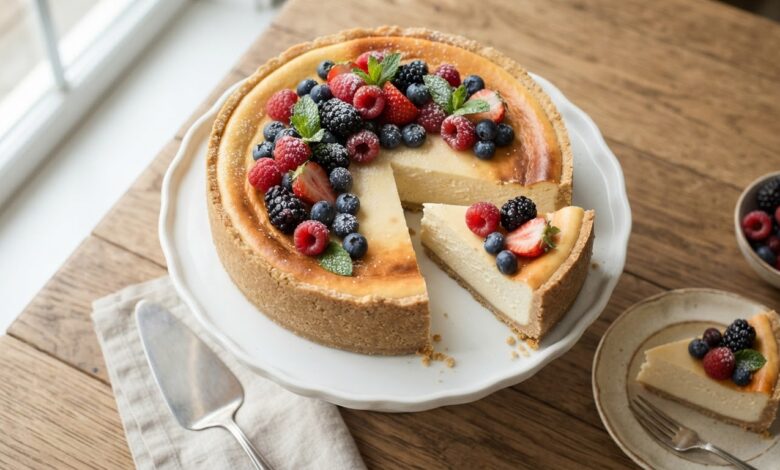
Low-Sugar Cheesecake with Almond Flour Crust (Sugar-Free Option)
This low-sugar cheesecake is a dense, creamy New York–style cheesecake baked on an almond flour crust, so it is gluten-free too. The filling uses half the sugar of a classic recipe, and the sweetener table shows how to make it fully sugar-free. Jump to the recipe, why the swaps work, crack-free baking and cooling, troubleshooting, storage or the FAQ.
At a glance: 9-inch springform · 12 slices · crust 350°F (175°C) for 8–10 minutes · filling 325°F (165°C) in a water bath for 60–70 minutes · chill at least 6 hours.
Low-Sugar Cheesecake Recipe
Prep: 25 minutes · Bake: 70–80 minutes total · Cool: 2 hours · Chill: 6 hours or overnight · Yield: 12 slices
Almond flour crust
- 1½ cups (168 g) blanched almond flour
- 4 tablespoons (56 g) unsalted butter, melted
- 2 tablespoons (24 g) granulated sugar, or the same amount of a granulated 1:1 erythritol blend or allulose for a sugar-free crust
- ⅛ teaspoon (0.7 g) fine salt
Filling
- 4 packages (8 oz each, 900 g total) full-fat brick cream cheese, at room temperature
- ½ cup (100 g) granulated sugar for low-sugar — or see the sugar-free options
- 1 tablespoon (8 g) cornstarch (gluten-free)
- ¾ cup (180 g) full-fat sour cream, at room temperature
- 2 teaspoons (10 ml) vanilla extract
- 1 tablespoon (15 ml) fresh lemon juice + 1 teaspoon (2 g) finely grated lemon zest
- 4 large eggs (200 g without shells), at room temperature
Method
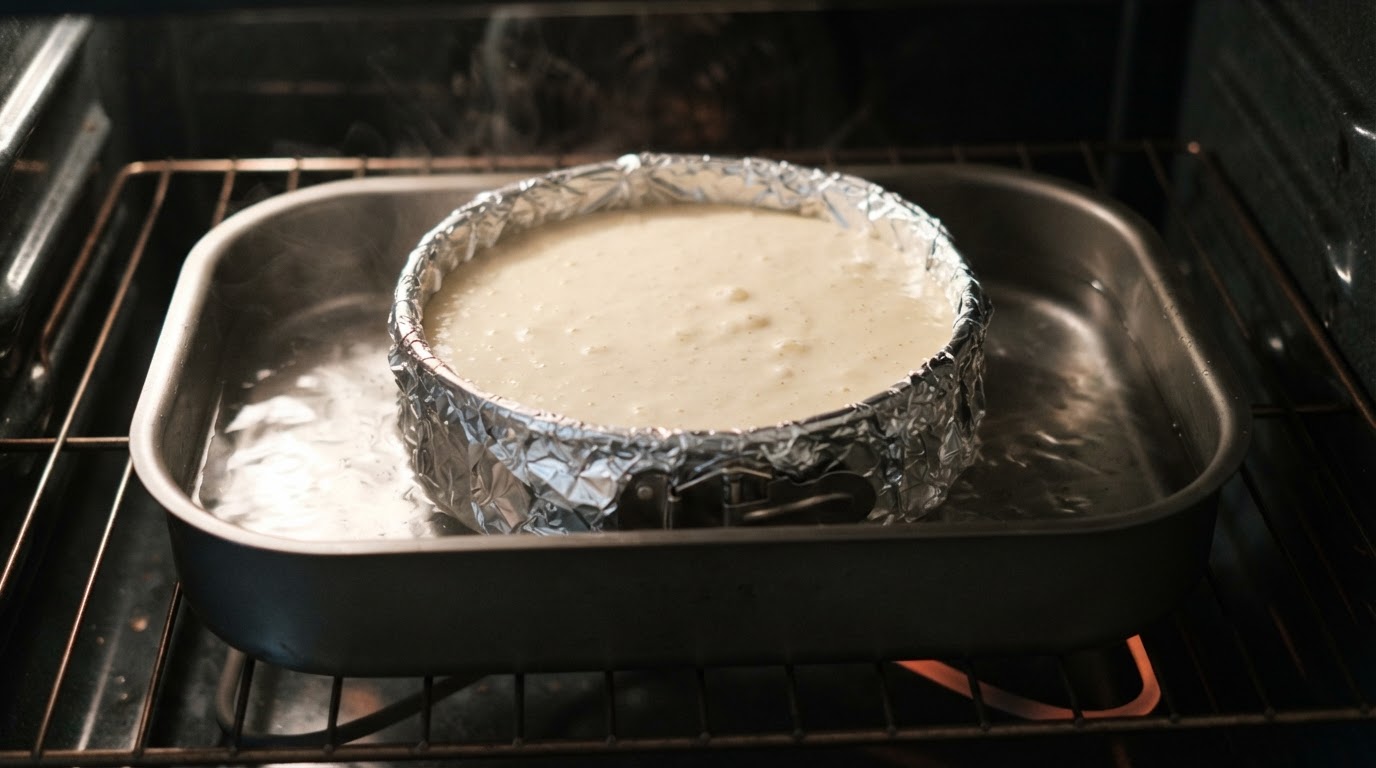
- Prepare the pan. Heat the oven to 350°F (175°C). Line the base of a 9-inch (23 cm) springform pan with parchment. Wrap the outside of the pan in two layers of wide heavy-duty foil, or set it inside a 10-inch cake pan or slow-cooker liner, so the water bath cannot leak in.
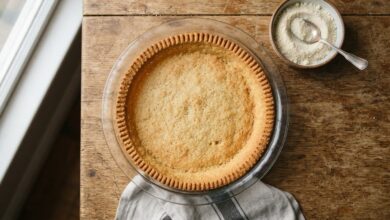
- Make the crust. Stir the almond flour, sweetener and salt, then the melted butter, until it looks like damp sand. Press firmly into the base (not up the sides) with the bottom of a measuring cup. Bake 8–10 minutes, until the edges are light golden. Cool 15 minutes. Lower the oven to 325°F (165°C) and put a kettle of water on to boil.
- Beat the cream cheese. On low to medium-low speed, beat the cream cheese for 2 minutes until completely smooth, scraping the bowl and paddle. Add the sugar (or sugar-free sweetener) and cornstarch and beat 1 minute more.
- Add the rest. Beat in the sour cream, vanilla, lemon juice and zest on low. Add the eggs one at a time on low speed, mixing only until each disappears. Scrape the bowl well. Do not whip: air bubbles are the main cause of cracks.
- Water bath. Pour the filling over the crust and tap the pan on the counter a few times to release bubbles. Set the springform in a roasting pan, place it on the oven rack and pour hot water into the roasting pan to come about 1 inch (2.5 cm) up the sides.
- Bake at 325°F (165°C) for 60–70 minutes (allulose: see the table), until the outer 2–3 inches are set and the center 3 inches still wobble like set gelatin when you nudge the pan. An instant-read thermometer in the center should read 145–150°F (63–65°C).
- Cool slowly. Turn off the oven, prop the door open about 2 inches (5 cm) and leave the cheesecake inside for 1 hour. Lift it out of the water, remove the foil, run a thin knife around the edge and cool on a rack for 1 more hour.
- Chill uncovered for 1 hour, then cover and refrigerate at least 6 hours, ideally overnight. Slice with a hot, dry knife, wiping it between cuts.
Low-Sugar and Sugar-Free Cheesecake: Sweetener Options
A classic New York cheesecake of this size uses about 1 cup (200 g) of sugar in the filling plus a sweetened graham crust. Choose your level below; amounts are for the filling only.
| Version | Filling sweetener | Bake at 325°F (165°C) | Approx. added sugar per slice* | Texture and taste |
|---|---|---|---|---|
| Classic (for comparison) | 1 cup (200 g) sugar | 60–70 min | about 19 g | Sweet, dense |
| Low-sugar (recipe above) | ½ cup (100 g) sugar | 60–70 min | about 10 g | Tangy, creamy; tastes clearly of cream cheese |
| Sugar-free: erythritol blend | 1 cup (about 160 g) powdered 1:1 erythritol–monk fruit blend | 60–70 min | 0 g | Very close to classic; slight cooling note, best fully chilled |
| Sugar-free: allulose | 1¼ cups (about 160 g) powdered allulose | 65–75 min (it browns faster — tent loosely with foil after 45 min) | 0 g | Softest, silkiest; no cooling note; slightly less firm |
| Half and half | ¼ cup (50 g) sugar + ½ cup (about 80 g) powdered erythritol blend | 60–70 min | about 6 g | Good middle ground if you notice the erythritol aftertaste |
*Estimates including the crust, based on 12 slices; cream cheese and sour cream also contain small amounts of natural milk sugar. Sweetener brands differ in sweetness and labeling, so check yours. This is general baking information, not medical or dietary advice — if you manage diabetes or another condition, read the labels and ask your healthcare provider what fits your plan.
Use powdered sweetener in the filling: granulated erythritol does not dissolve fully in cold, thick cream cheese and leaves a gritty texture. You can grind granulated sweetener with a little cornstarch — see how to make sugar-free powdered sugar.
Why These Low-Sugar and Gluten-Free Swaps Work
- Cheesecake does not need much sugar for structure. Eggs and cream cheese proteins set the filling. Sugar mostly adds sweetness and a little tenderness, so halving it changes the taste more than the texture; sour cream and lemon keep the tang balanced.
- Cornstarch is insurance. One tablespoon helps the eggs set smoothly and makes the filling less likely to crack, which matters more with sugar-free sweeteners that hold less moisture than sugar.
- Erythritol vs allulose. Erythritol blends bake almost like sugar but can recrystallize and taste cool; the fat in cheesecake masks this well. Allulose stays soft and browns at lower temperatures, so it needs foil tenting and a few more minutes to set.
- Almond flour makes a naturally gluten-free, low-sugar crust. Its fat and protein bind with melted butter and brown in 8–10 minutes, and it needs only 2 tablespoons of sweetener. More options are in our almond flour cheesecake crust guide.
How to Bake and Cool a Cheesecake Without Cracks
- Have the cream cheese, sour cream and eggs at room temperature (about 1–2 hours out of the fridge) so the batter is smooth without long beating.
- Mix on low speed after the eggs go in, and tap the pan to release bubbles.
- Use the water bath: it keeps the edges from overbaking before the center sets.
- Take it out while the center still wobbles; 145–150°F (63–65°C) is the target. Above 160°F (71°C) the filling tightens and cracks.
- Cool in the turned-off oven with the door ajar, then loosen the edge with a knife so the shrinking cake does not tear.
Low-Sugar Toppings
- Fresh berries: 2 cups (about 280 g) mixed berries tossed with 1 teaspoon lemon juice and 1–2 teaspoons sweetener of choice.
- Sour cream topping: stir 1 cup (240 g) sour cream with 2 tablespoons (16 g) powdered sweetener and ½ teaspoon vanilla. Spread over the baked cheesecake right after the 1-hour oven rest and bake 10 minutes more at 325°F (165°C); it hides any small cracks.
- Quick berry sauce: simmer 2 cups (280 g) frozen berries with 2 tablespoons water and 1–2 tablespoons sweetener for 8–10 minutes; cool before serving.
Troubleshooting
| Problem | Likely cause | Fix next time |
|---|---|---|
| Cracked top | Overbaked, too much air, or cooled too fast | Pull it at 145–150°F (63–65°C); mix on low; cool in the oven with the door ajar |
| Lumpy filling | Cold cream cheese | Soften fully; beat the cream cheese alone until smooth before adding anything |
| Gritty sugar-free filling | Granulated erythritol | Use powdered sweetener or grind granulated in a blender |
| Soggy crust | Water bath leaked | Use two layers of wide heavy-duty foil or set the springform inside a larger cake pan |
| Crust crumbles when sliced | Not pressed firmly or underbaked | Press hard with a flat cup; bake until the edges are golden |
| Top too brown (allulose) | Allulose browns faster | Tent loosely with foil after 45 minutes |
| Center still runny after chilling | Underbaked | Bake until the outer ring is set and the center reads at least 145°F (63°C) |
Storage and Make-Ahead
Refrigerate the cheesecake, covered, for up to 5 days; it tastes best on day 2. Add fresh fruit just before serving. To freeze, chill it completely, wrap the whole cake or individual slices in plastic wrap and then foil, and freeze up to 2 months. Thaw overnight in the fridge, still wrapped, to avoid condensation on top. Sugar-free erythritol cheesecakes can firm up slightly in the fridge; let slices sit at room temperature for 15 minutes before serving.
Low-Sugar Cheesecake FAQ
How much sugar is in a low-sugar cheesecake?
This recipe uses ½ cup (100 g) of sugar in the filling and 2 tablespoons in the crust — roughly 10 g of added sugar per slice, about half of a classic cheesecake. The sugar-free versions have no added sugar.
What is the best sugar substitute for cheesecake?
A powdered 1:1 erythritol–monk fruit blend gives the closest texture to a classic cheesecake. Powdered allulose gives the smoothest, softest result with no cooling aftertaste, but it browns faster and needs a slightly longer bake.
Is this cheesecake gluten-free?
Yes. The crust is almond flour and the filling is thickened with cornstarch. Check that your cornstarch, vanilla and sweetener are labeled gluten-free if you bake for someone with celiac disease.
Can I make it without a water bath?
Yes: set a pan of hot water on the rack below the cheesecake instead, and bake at 300°F (150°C) for 75–85 minutes. The edges set a little firmer and the risk of cracks is higher, so the slow cooling step matters even more.
Can I use a graham cracker crust instead?
Yes. Use our graham cracker crust for cheesecake (it includes a gluten-free and a low-sugar version). Note that regular graham crackers add sugar and gluten.
More cheesecake and free-from baking: the classic simple creamy cheesecake, cheesecake cupcakes with a low-sugar option, pumpkin cheesecake, our sugar-free yellow cake mix and more gluten-free dessert recipes.